

How the Supreme Court’s 2025–2026 LGBTQ+ Docket Could Redefine Civil Rights

It has been over ten years since Obergefell v. Hodges recognized same-sex marriage as a constitutional right. Yet, state legislatures have passed hundreds of laws targeting transgender people, banning gender-affirming care for minors, barring trans athletes from competing, and stripping LGBTQ+ protections from schools and public spaces. That wave of new legislation has made LGBTQ+ issues/rights a hot topic for the Supreme Court. The 2025–2026 term has put three landmark cases before the Court: Chiles v. Salazar, Little v. Hecox, and West Virginia v. B.P.J. Decisions are expected by late June of 2026.
The core problem is simple: your legal rights as a transgender person in America depend, more than anything else, on your zip code, and the Supreme Court has the power and the responsibility to change that. Without the Court and a federal standard set, minor state laws will leave transgender and queer Americans exposed to normalized discrimination, denied healthcare, and much more.
The closest the law came to rectifying the state laws was Bostock v. Clayton County. A 6–3 majority held that Title VII ban on sex discrimination in employment includes discrimination based on gender identity and sexuality. Justice Gorsuch, writing for the majority, reasoned that firing someone for being transgender is by definition treating them differently because of their sex.
But the majority opinion explicitly confined its holding to employment. States exploited that gap almost immediately. If Bostock only protects trans people at work, their argument goes, then nothing stops legislatures from regulating trans people in schools, hospitals, sports, and public life however they want. The result has been a civil rights island surrounded by a sea of permissible discrimination. And transgender minors, who have no vote, no legal standing of their own, and no political voice, pay the highest price.
On January 13, 2026, the Court heard oral arguments in Little v. Hecox and West Virginia v. B.P.J., two consolidated cases challenging state laws that bar transgender girls and women from competing on girls' and women’s sports teams. Idaho’s HB 500 and West Virginia’s HB 3293 both classify eligibility by sex assigned at birth and impose invasive sex-verification procedures on female athletes. Lindsay Hecox, a transgender woman at Boise State, was barred from trying out for the women’s track team. Becky Pepper-Jackson, a 15-year-old trans girl in West Virginia, was told she could not run cross country.
Chiles v. Salazar, No. 24-539, is a different kind of fight entirely. At issue is Colorado's 2019 Minor Conversion Therapy Law, which prohibits licensed mental health professionals from attempting to change a minor's sexual orientation or gender identity. The law explicitly allows therapists to help young people explore their identities, but it bans pressuring them toward a specific outcome. Petitioner Kaley Chiles, a licensed Colorado therapist, argues this violates her First Amendment right to free speech. The Court heard arguments on October 7, 2025, the first time it has ever taken up a conversion therapy case.
Every major medical and mental health organization in the U.S., including the American Psychiatric Association, the American Psychological Association, and the American Medical Association, has condemned conversion therapy as a discredited practice that significantly increases rates of depression, anxiety, and suicide in LGBTQ+ youth. Colorado defended its law as a permissible regulation of professional conduct, not speech. But after arguments, a majority appeared skeptical of a potential ruling that would threaten similar bans in more than twenty other states.
While the Court deliberates, no one is waiting. States with Democratic-led legislatures have been moving preemptively to strengthen trans-protective laws, trying to shield residents from whatever rulings may come down. These efforts acknowledge a hard political reality: federal constitutional protections may not be coming, and states that want to protect their transgender residents will need to do it themselves.
The 2025–2026 Supreme Court term has concentrated in a single year on questions that the law has been deferring for decades. The rights of transgender Americans, to healthcare, to participate in sports, to receive responsible therapy, to carry accurate government ID, rest right now on the votes of nine justices.
What the Court cannot escape is the inadequacy of the existing framework. The Equal Protection Clause, Title IX, and even Bostock’s expansive reading of Title VII; none of it was built with transgender identity in view. The gaps are everywhere. Protections apply at work, but maybe not at school. They exist in some states and not others. A transgender teenager in California lives in a fundamentally different legal world than a transgender teenager in Tennessee or West Virginia. That is not equal protection. That is a patchwork.
Even sweeping rulings, in either direction, will not resolve that fundamental tension. What is really needed, and what the Court alone cannot provide, is comprehensive federal legislation that explicitly extends civil rights protections to transgender Americans across all domains of public life, such as healthcare, education, sports, identification, and employment. Congress has the power to do what the Court has so far declined to: define, once and for all, what equal protection actually means.
Until that happens, the rights of transgender people in America will remain where they are today, dependent on geography, contingent on which administration holds power, and perpetually one Supreme Court term away from being quietly dismantled.
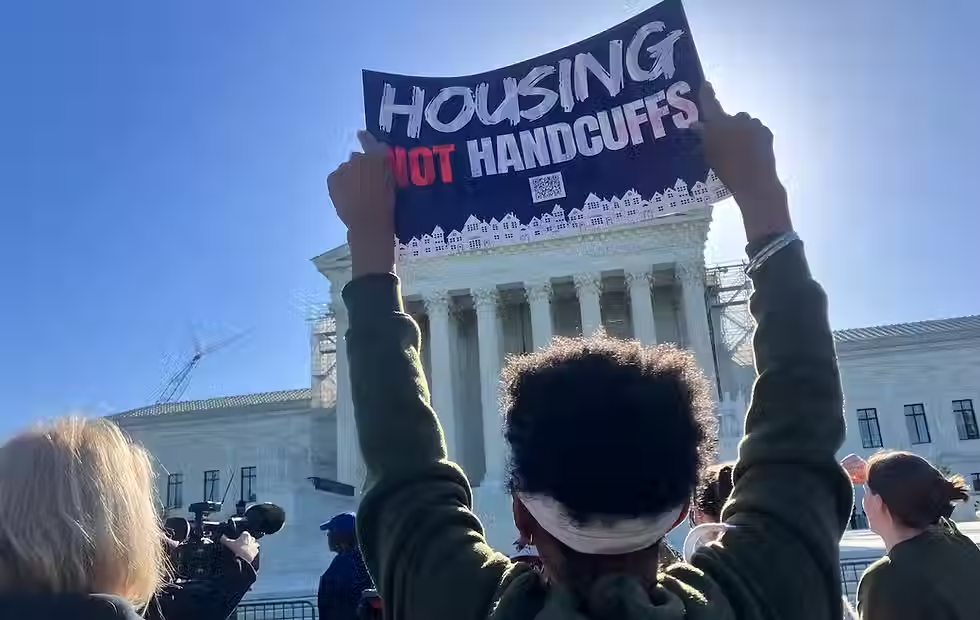
Image Source: Vox


Comments